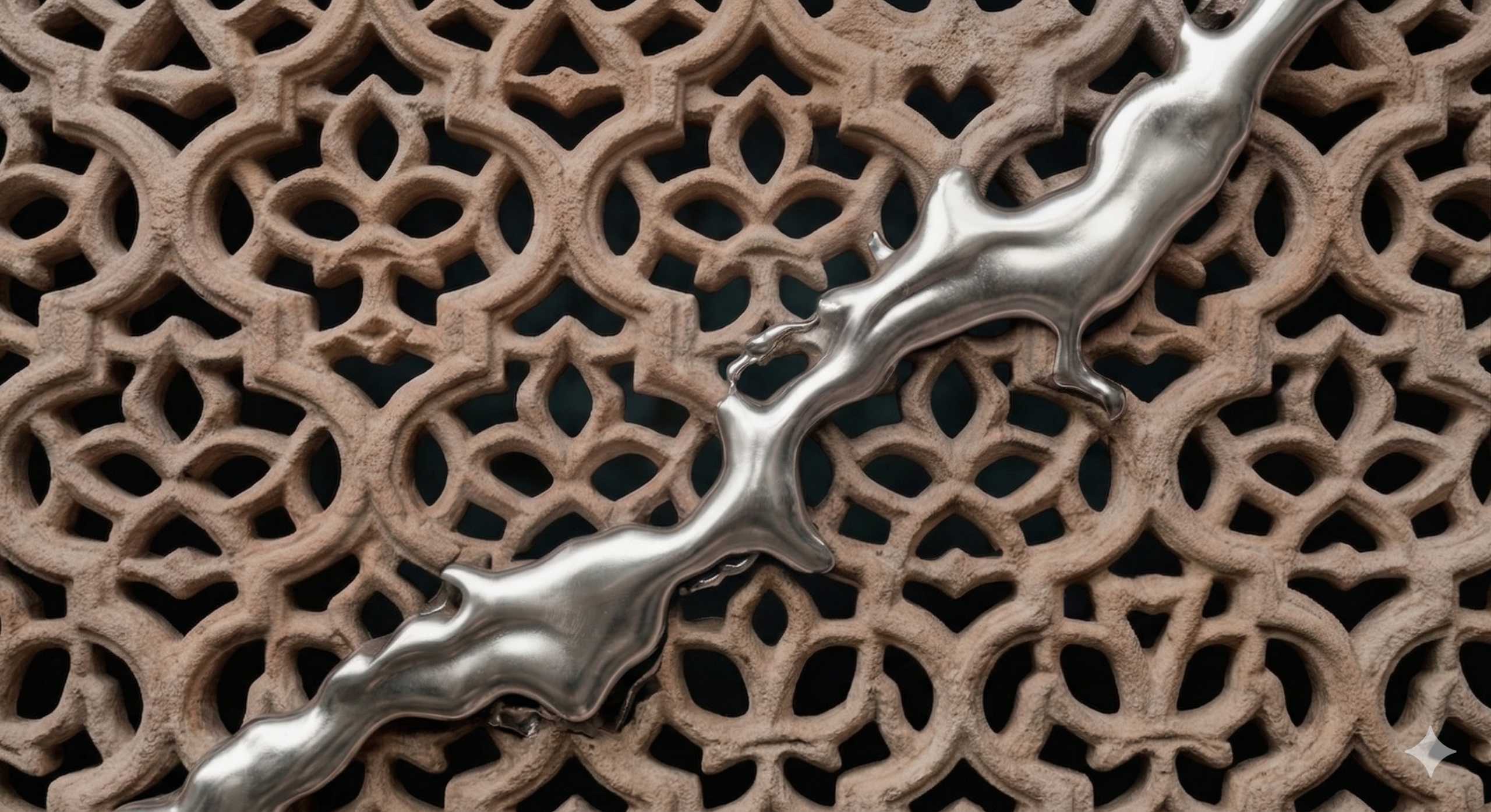
India has the wealth, the mythology, the craft, the hunger. What it doesn’t have yet is a luxury brand that knows — without flinching — what it believes about the world. That’s not a design problem. It’s a belief problem.
In June 2025, Pharrell Williams spent seven days in Delhi, Mumbai, and Jodhpur. He wandered markets, visited ateliers, sat with artisans. Then he went back to Paris and built the Louis Vuitton Spring/Summer 2026 menswear show around what he found — Bijoy Jain of Studio Mumbai designing a hand-painted Snakes and Ladders runway, an A.R. Rahman soundtrack, turmeric and cinnamon and coffee-indigo woven through the collection. He called it reverence. The Indian press called it breathtaking.
Three weeks later, Prada sent Kolhapuri chappals — traditional handcrafted sandals with a Geographical Indication tag, made from sun-dried buffalo hide, shaped entirely by hand, rooted in craft traditions stretching to the 12th century — down their Milan runway. They described them as “leather flat sandals.” No acknowledgement. No credit. No reverence.
CNN · July 2025
“The episode epitomizes how Western labels have often struggled to meaningfully engage with the country’s crafts and culture — even as India’s luxury market surges toward $11.3 billion by 2028.”
Two brands. Two approaches. One continent, watching both, and still not quite building what should already exist: a homegrown luxury brand that doesn’t need to prove itself to Paris, that doesn’t need Pharrell Williams to point at it and say this is worth something.
The question I keep returning to is: why not? India has everything luxury requires except one thing. And that one thing isn’t money, or craft, or consumer appetite. It’s a clear answer to the question every great luxury brand has to answer first — what do we actually believe about the world?
✦
$85B
Projected value of India’s luxury market by 2030India’s luxury sector is currently valued at $17 billion. The ultra-high-net-worth population is expected to grow 50% by 2028. The consumers exist. The spend exists. The belief system hasn’t caught up.
Let me be precise about what I mean. There are Indian luxury brands I admire. Sabyasachi Mukherjee built something genuinely extraordinary — a $100M+ empire rooted in what he calls “organized chaos,” revival of Banarasi silk and hand-dyed velvets, a philosophy of “personalized imperfection” that draws from French Impressionists and Awadhi weaves in the same breath. He is, arguably, the closest thing India has to a luxury house with a real philosophical centre.
But even Sabyasachi is primarily a bridal designer. Which means even our best example of Indian luxury is built around one event — the wedding — rather than a worldview that a customer can inhabit across their whole life. Hermes isn’t a wedding brand. Bottega Veneta isn’t a wedding brand. They’re brands with a point of view about how life should feel, and the products are expressions of that point of view. Indian luxury hasn’t made that leap yet.
“We’re seeing a beautifully diverse audience — from second-gen industrialist families to first-gen digital entrepreneurs, artists and global citizens — who are all looking for something deeper than just a logo.”Gaurav Gupta, fashion designer · CNN, July 2025
Gaurav Gupta is right. The consumer is ready. The Indian Gen Z luxury buyer INSEAD’s research identified — the “Nuance Seeker,” the “New Maharaja” who wants quality over logos, who whispers rather than screams, who is globally literate and culturally grounded — this person is waiting for a brand that matches their complexity. They’re not waiting for a better version of a European luxury house. They’re waiting for something that couldn’t have come from anywhere else.
The problem isn’t craft. It’s conviction.
Here’s what confuses me about the Indian luxury conversation. Every white paper, every summit, every INSEAD research note says the same thing: India needs to “craft a global identity rooted in heritage.” The Luxury Roundtable 2026, the World Luxury Chamber, Avendus — all agree that India should be building something equivalent to a Western Maison, but grounded in Indian traditions.
I don’t disagree. But I think the framing is still wrong. It’s still oriented outward — toward global recognition, toward the Western gaze, toward building something that “resonates globally.” And that orientation is the problem.
The French didn’t build Hermes by asking what would resonate globally. They built it by being uncompromisingly themselves — obsessed with equestrian heritage, with the idea that a single craftsperson should make an entire bag start to finish, with the belief that the best things are slow. The global resonance came later, as a consequence of that conviction. Not the other way around.
Indian luxury brands that are trying to “go global” before they’ve answered the domestic belief question have the sequence backwards. You don’t build the identity for the world and then bring it home. You build something true — true to a specific worldview, a specific way of understanding beauty or time or value or story — and then the world finds it.
What would that look like? I’ll tell you what I think it doesn’t look like. It doesn’t look like Mughal motifs on everything. It doesn’t look like “heritage meets modernity” as a tagline. It doesn’t look like a campaign shot in Rajasthan with a white model in a lehenga. Those are aesthetics. They’re borrowed atmospheres. They’re not beliefs.
✦
What a belief actually looks like in a luxury brand
A belief is a claim about the world. Bottega Veneta’s belief — invisible to most, legible to those who know — is that the most refined things leave no trace of how they were made. The craft disappears. Only the quality remains. That’s not a tagline. It’s a way of understanding value that shapes every design decision, every material choice, every campaign.
Loro Piana believes that the best raw materials in the world, untouched, speak louder than anything you could add to them. Dieter Rams, whose work shaped a generation of product design, framed it as: good design is as little design as possible. These aren’t aesthetic preferences. They’re philosophical positions about what matters.
What could India’s equivalent be? I have a few hunches — not answers, but directions worth following.
India has always understood that the object is not separate from the hand that made it. The artisan is inside the artifact in a way that industrially produced luxury can never replicate. That’s not nostalgia — that’s a genuinely different theory of value, and it’s one that a certain kind of global consumer is actively looking for in 2026, as the K-shaped luxury market rewards meaning over scale.
India also has a relationship to time that luxury could draw from. Not the Western luxury relationship to heritage — “established 1837,” the weight of institutional history — but something older and stranger. The idea that a thing can be ancient and urgent at the same time. That mythology is not the past but a living system. That a piece of jewellery can be a key, not an ornament.
Avendus Future Leaders Fund · January 2026
“It is not about imitating Western luxury models. It is about defining a new language of luxury, grounded in Indian traditions yet articulated with global sophistication. With the right vision and ambition, Indian enterprises can shape the next LVMH — not by replication, but through innovation anchored in identity.”
I agree with this. But I’d push it further: the innovation has to start with the belief, not with the business model. The question isn’t “how do we build an Indian LVMH.” The question is: what does this brand hold to be true about the world? What would it refuse to do, even if it were commercially convenient? What would it fight to protect, even if no one was watching?
The brands that answer that question clearly — not for a pitch deck, not for a launch campaign, but in the room, before any of the product decisions — those are the ones that will still be here in 30 years. The ones that are imitating European luxury codes, or over-explaining their Indianness to a Western audience, or pivoting between heritage and modernity depending on the season — those are the ones that will be forgotten, or worse, absorbed.
The moment is real. The urgency is real.
In 2026, the European luxury giants are vulnerable in a way they haven’t been in decades. Kering’s profits fell 50% in 2024. Gucci dropped 25%. LVMH returned to just 1% growth in Q3 2025 after several quarters of decline. The playbook that made them dominant — scale, visibility, aspiration through ubiquity — is actively working against them now. The IMD’s luxury outlook for 2026 puts it plainly: “relevance must be earned.” Clarity of value and cultural legitimacy matter more than size.
This is the window. Not to imitate what they built in their prime, but to build something that the next generation of globally minded, culturally serious luxury consumers — in India and everywhere else — has been waiting for without knowing what to call it.
Pharrell Williams spent seven days in India and built a show that made the world pay attention. That’s not an accident. It’s a signal. The raw material is here. The cultural depth is here. The consumer is here. The craft is here.
What’s missing is a brand willing to go into a room, before any of the product decisions, before the brand guidelines, before the campaigns — and answer the hard question first.
What do we believe?
Not about heritage. Not about sustainability. Not about global resonance. About the world. About what makes something worth making. About what a person is reaching for when they reach for something beautiful.
When an Indian luxury brand answers that question and means it — the rest will follow. It always does.
✦
Indian Luxury. Brand Strategy. Cultural Read. Belief-Led Branding
References:
CNN (July 2025) · INSEAD Knowledge (Feb 2025) · Avendus Future Leaders Fund (Jan 2026) · IMD Luxury Trends 2026 · Luxury Roundtable Outlook Summit 2026